Friday, August 30, 2013

Water Education Network Now Online

A Water Education Network to help people in Texas learn the  best ways to manage the precious resource has been launched by the Texas A&M AgriLife Extension Service.

The site, http://water.tamu.edu,  provides a “front door” for all of AgriLife Extension’s information on water conservation, water management, irrigation and water quality, which makes it easier to navigate, according to the developers.

The Water Education Network contains information useful for homes, residential and city landscapes, and agricultural and wildlife management. Water-related programs are organized in three main categories: conservation, management and irrigation, and quality. It is organized so that those topics are easy to reach either directly on the site or with search engines. The key is to get important facts and how-to information to the people as easily as possible.”

Viewers of the website can find links to water-related events, classes and trainings offered by AgriLife Extension throughout the state, and can subscribe to receive email updates.

Water conservation topics and publications on the site include: Water Conservation at Home, Youth Water Resources, Conserving Residential Water Through the 40-Gallon Challenge, Landscape Water Conservation using Earth-Kind Landscaping, Water Conservation and Technology Center, and Biological Control of Aquatic Weeds and Saltcedar.

In the water management and irrigation section, viewers will find: Stormwater Management Program, Rainwater Harvesting, The School of Irrigation, Irrigation and Agriculture, Rebuilding the Beef Herd (after Drought), and Managing Ponds and Lakes on Private Lands.

Water quality is addressed with: Protecting Texas Watersheds, Attoyac Bayou and Bacterial Source Tracking, Onsite Waste Water Treatment Systems, Texas Well Owner Network, and Animal Manure and Process Waste Water Management.

Other publications already available are: Home Water Conservation Tips and Checklist, Energy Star Appliances Overview, Home Water Quality Problems – Causes and Treatments, Rainwater Harvesting System Overview and Making a Rain Barrel.

Ranch Management University Scheduled at Texas A&M

New landowners interested in learning to manage their ranch’s resources while protecting the environment can do so during the annual Texas A&M AgriLife Extension Service Ranch Management University on the Texas A&M University campus in College Station.

The workshop is scheduled Oct. 28 through Nov. 1 at the TAMU Beef Center, 7707 Raymond Stotzer Parkway, said Dr. Larry Redmon, AgriLife Extension state forage specialist.  “Applying fertilizer based on soil test recommendations and using pesticides in accordance with the pesticide label are important parts of protecting our environment and valuable water resources,” Redmon said.
“Ranchers are important stewards of our state’s valuable natural resources, and we want to ensure new landowners get off to a good start. We do this with the goal of optimizing economic return while at the same time protecting the environment. This helps with our additional goal of producing safe food products.”

Registration is $500 and attendance is limited to the first 50 people who enroll. Slots will go fast, so he advised those interested to not wait to get registered. To register online and for more information, go to http://agriliferegister.tamu.edu and enter “ranch management” into the search window.
Redmon said the intensive five-day workshop is offered twice a year. This fall session will cover the fundamentals of soils and soil fertility, forage establishment, pasture management and livestock and wildlife management. Grazing management, stocking rate and body condition scoring will be highlighted, and horse and small ruminant management presentations will be conducted.

Additionally, several wildlife management topics are on the program for those interested in managing white-tailed deer, turkey, feral hogs and farm ponds. Various forage species, including Bermuda grass and other introduced forages, native forages, small grains, annual ryegrass and clovers will be studied by workshop attendees.

Approximately one-half the workshop involves lectures and discussion, Redmon said, with the remainder consisting of the field demonstrations.  “Field demonstrations will include learning how to properly calibrate a sprayer, assess body condition scores of cattle, obtain proper soil and hay samples, and to assess the fish populations in ponds,” Redmon said. There will also be a discussion regarding pond weeds and a demonstration on hog-trap design.

Time at the workshop will be allowed for interaction with Texas A&M faculty with expertise and experience in all management facets of the soil-plant-animal interface and wildlife management.
Meals and break refreshments are covered by the registration fee, along with a resource CD containing more than 100 publications covering ranch resource management.
For additional information, contact Redmon at 979-845-4826 or l-redmon@tamu.edu .

Friday, August 23, 2013

FALL EXPO SCHEDULED


HUNT COUNTY HAY SHOW ENTRIES


            Entries are currently being accepted for the annual Hunt County Hay Show. Many factors have affected hay production the past several years, including rainfall, and rising costs of fertilizer and fuel. What better time to take advantage of a free analysis of your hay, to find out the quality of what you have produced.
           Having an analysis of your hay sample can allow you to feed livestock much more efficiently, supplementing only what your livestock need during the winter feeding season.
            Entries are due by 5 p.m., Wednesday, September 4, for the show. We hope you are making plans to enter, and will get your samples delivered.
            Entering the show is simple. Producers must take any entries to a drop location, complete an entry form, and you are done. The Extension Office and members of the Ag and Livestock Committee will pick the samples up, have them tested for crude protein, TDN and ADF, and get them ready for the show. It is important to note that entering is free. The fee for testing is provided by the Noble Foundation, and is normally worth $15 per sample.
The following locations will accept entries: NET Farmers Co-op (both the store and fertilizer plant) in Greenville, and Huffman Farm Supply in Commerce.
            We ONLY require a feed sack full of hay to constitute an entry. Samples filling a 50 pound paper feed sack, are all we will accept. We still need plenty of hay for testing and preparing entries for the county show, so for your entry sample, you may put 2-3 blocks from a square bale or a sample from the center of a large round bale to fill the feed sack. Please do not use plastic bags, as they cause the sample to mold before the show, and could cause disqualification.
            Classes include legumes and legume (clover) grass mixes; forage sorghum, sudans, hybrid sudan, and johnson grass; bermudas; small grains and winter annuals; and other, which includes prairie, grass mixes, etc.
Hay will be judged on protein score, and acid detergent fiber (ADF). Entries will not be accepted that have injurious foreign material, hardware, or are moldy, caked, dusty, or badly weathered.
            The actual Hay Show and meal will be held on October 3, 2013 at the Fletcher Warren Civic Center in Greenville.  Hay show winners will be announced that same evening. Tickets, will be available at the drop off locations and the County Extension Office, and are $10 per person, and are required to ensure a meal at the show.
            We hope you will get your entries in for the show. Remember, there is no entry fee, and it is open to all Hunt County producers. Also, if you are worried that your hay may not be competitive, give the show a try anyway. Only blue ribbon hay will be identified as to the producer, but you may be surprised, and find you have better hay than expected. You will also take home lots of information about the quality of your hay when feeding it to livestock.
            If you would like any further information, please contact the Hunt County Extension Office at (903)455-9885, and we will be glad to discuss details of the hay show with you. Hay show rules and entry forms follow for your use. 


Tuesday, July 30, 2013

What to do if you’re attacked by bees?


Shared from Insects in the City
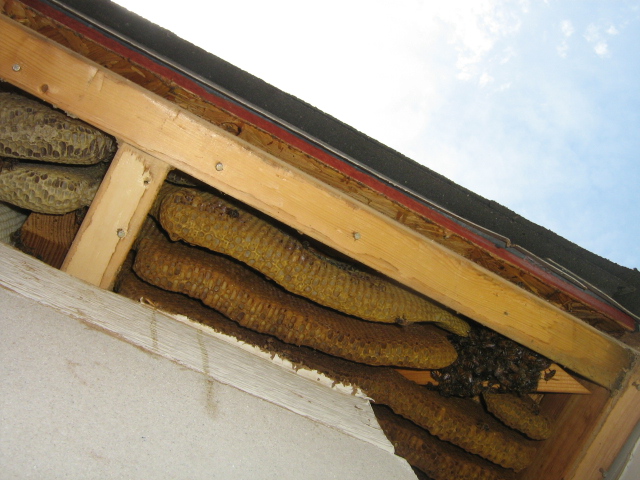
bee hive in soffit area of home
A few bees entering a home usually means a nest is somewhere inside. This colony in a roof soffit likely consists of 30,000 or more bees. The unpredictability of bees means that a normally peaceful nest can turn dangerous quickly.

While honey bees are highly beneficial to man, they can also be dangerous.  If you don’t believe this, consider two Texas incidents this summer.  In June, a Waco area man was killed by honey bees while working on his tractor.  This past weekend a couple was severely stung and two of their miniature horses were killed following a bee attack at their Tarrant county home.  Both incidents illustrate how serious honey bee infestations can be.
It’s not that bees are mean, in a human sense. But they do take exception to any people or animals that threaten their nest, or colony.

So what should you do if you are attacked by bees?
Run!  Some people make the mistake of standing in place and swatting bees, but this only gives bees more time to recruit from the colony, and results in more stings.  Get to shelter as quickly as you can.  Get in a car or building that can be securely shut.  If you encounter stinging bees and are a long way from shelter, try to run through shrubs or brush to distract the bees.  If there is no shelter nearby, keep running until you leave the bees behind. Some bees may pursue victims a half mile or more before giving up the chase.
Don’t be fooled into seeking escape in water.  According to the Fort Worth Star Telegram article, after failing to swat and swipe off the bees, the Tarrant county couple tried diving in their pool. “We were trying to stand up in the water but every time we stuck our heads out for air, they would cover us and start stinging us,” she said. “We were trying to breathe and they were stinging us in the face and in the nose.” Water is a poor shelter from bee attack.
Once you’ve escaped the swarm, remove any stingers from your skin as soon as possible. Honey bees are one of the only stinging insects that leaves its stinger in the skin.  Left in the skin, the accompanying venom sac will continue to pump venom.  Pull the stingers out with a knife blade scraped gently across the skin, or by scraping off with your finger nails.
Seek medical attention immediately, especially if you experience hives, swelling around the throat or face, or difficulty breathing. While an average  healthy adult may able to withstand hundreds of bee stings, for people with bee venom allergies even a single sting can be highly dangerous.
Honey bee attacks have received more media attention since Africanized honey bees entered the country in the early 1990s. Africanized bees, while physically identical to domesticated European bees first brought by settlers to this country about 300 years ago, are genetically predisposed to be more aggressive than the European bee.  Africanized bees typically have a lower tolerance for nest disturbance, will send more bees out in pursuit of an intruder, and will chase victims further than their European cousins.

All wild bee colonies in Texas should be assumed to be a hybrid between Africanized and European wild bees.  Beekeepers usually ensure that their colonies are founded on the more docile European bees, so the threat from domesticated bees is less than wild bees.
All of this is good reason to be wary of any wild honey bee nest in your home or on your property.  A licensed beekeeper or pest control professional can help you get rid of bees.  For more information, see our publication E-346, Honey bee control in and around homes.

Tuesday, May 28, 2013

New animal identification rules aid disease traceability


NEWS RELEASE
For Immediate Release – May 22, 2013

ARDMORE, Okla. —On March 11, 2013, the United States Department of Agriculture (USDA) initiated the Animal Disease Traceability Program (ADTP) to track interstate livestock movement. The new rule replaces the previous version of the National Animal Identification System (NAIS) and pertains to all livestock, including cattle, horses, sheep and goats.

According to the USDA, knowing where diseased or at-risk animals are, where they have been and when, is important to providing a rapid response when animal disease events take place. This will reduce the impact of an animal disease event.

Noble Foundation Livestock Consultant, Robert Wells, Ph.D., said the ADTP will require livestock that move interstate to be accompanied by an Interstate Certificate of Veterinary Inspection (ICVI), owner-shipper statement or a brand certificate. The owner-shipper statement and brand certificate must be approved by officials in both the state of origin and the receiving state. Animals moved intrastate will be under the jurisdiction of the state’s regulations.

For cattle, the following are deemed officially accepted forms of identification:
  • Metal ear tags (brucellosis “orange” tag or National Uniform Eartagging System “Brite” tag).
  • Plastic ear tags (with or without RFID, but must have a unique 15-digit code with 840 as the first three digits, the U.S. shield and manufacturer’s logo or trademark).
  • Group or lot identification when applicable.
  • Brands, when recognized by a brand inspection authority, accompanied by an official brand inspection certificate and allowed by the receiving state.
  • Ear tattoos acceptable to breed registries when accompanied by a breed registration certificate or back tags when cattle are moved directly to slaughter.

Cattle are exempt if they are moved directly to a livestock slaughter facility or to an approved livestock tagging facility with an owner-shipper statement; moved from farm of origin to a veterinary medical facility and then returned to the farm of origin (directly from one state through another state and back to the original state); or moved as a commuter herd with a copy of the commuter herd agreement.

“Ordinarily there is no requirement for a producer to maintain a copy of the movement document, but it is highly recommended that records be kept,” Wells said. “However, if an animal loses an official ear tag, a replacement may be used. If this occurs, then records that indicate the new identification number, the date it was implemented and the old number must be maintained for five years.”

As beef cattle producers manage their herds now and into the future, they will need to make sure that cattle have compliant identification and they maintain those records necessary for USDA compliance.

Federal rules require the following animals to be officially identified:
  • All sexually intact dairy cattle.
  • All rodeo, exhibition or event cattle and horses.
  • Sexually intact beef cattle over the age of 18 months.
  • Equines that move interstate.
  • Existing sheep and goat scrapie regulations apply.

Thursday, February 21, 2013

SPRING EXPO EVENT SCHEDULED

          Spring is just around the corner, and with the arrival of spring comes the need to get pastures and hay meadows fertilized, work cattle, and plan for changes to be made in the coming months. To celebrate the arrival of springtime, Texas AgriLife Extension in Hunt County and the Northeast Texas Farmers Coop in Greenville will be sponsoring a Spring Expo on Wednesday, February 27.
            This event will be held from 10 a.m. to 3 p.m. at the Fletcher Warren Civic Center, 5501 Business Highway 69, in Greenville. There will be many vendors showcasing their products and answering producer questions regarding, pastures, cattle management, fencing, vet supplies, herbicides, livestock supplements, and other agricultural products.
         Talks will be given to update producers on sprayer calibration, weed control and herbicides, improving pastures, soil testing, fertilizing, rotational grazing, and more. In addition at noon, there will be a hamburger lunch provided free of charge to all participants, and many door prizes will be given away.
            The event is free of charge to all attending, compliments of the NET Farmers Coop. A  RSVP 

is requested by February 26. More information can be obtained, and reservations can be made by 

calling the Coop at 903-455-6365 or the Extension Office at 903-455-9885.