Friday, February 7, 2014

Carpenter Ants Swarming


 Provided by Insects in the City, Dr. Mike Merchant, Extension Urban Entomologist
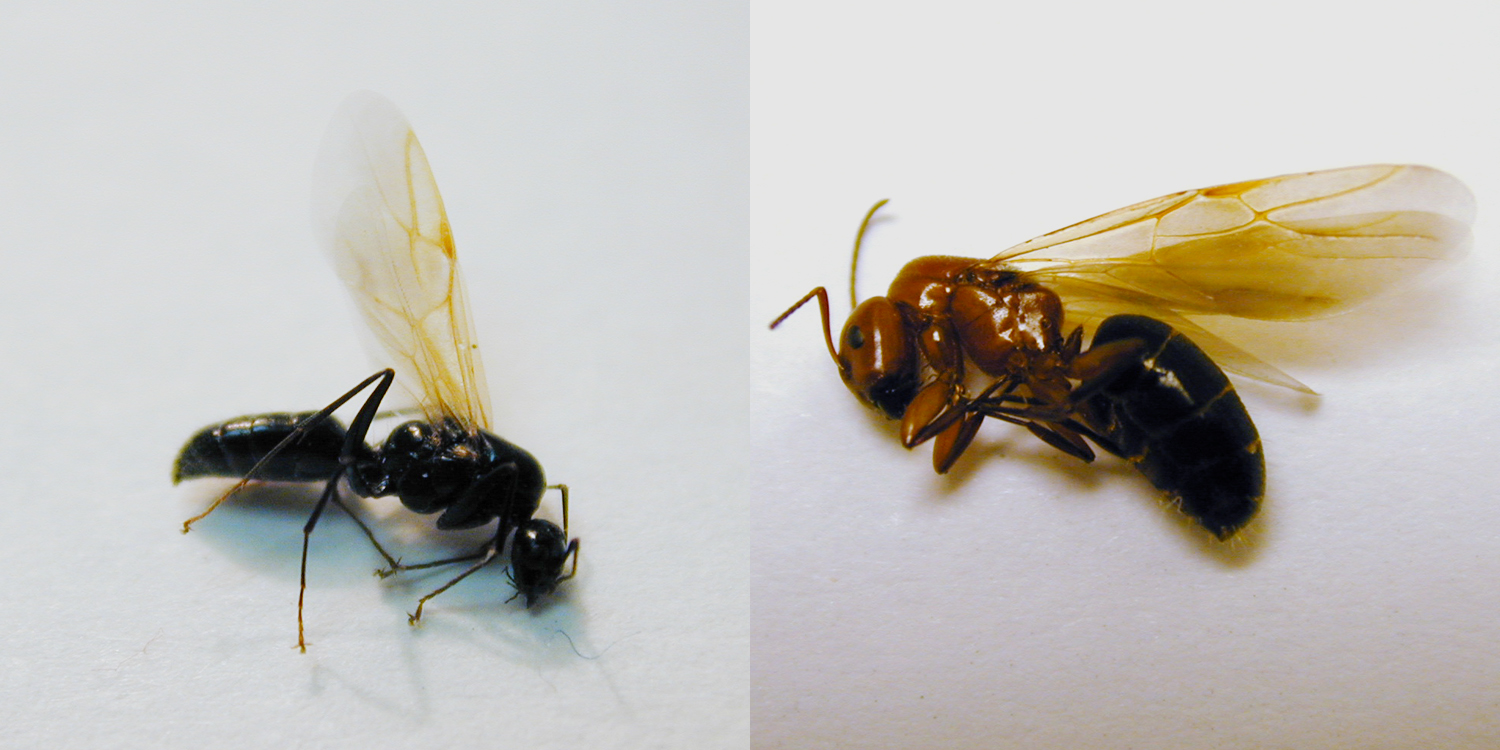
Campanotus swarmers
Photos: Male (left) and female carpenter ant swarmers.
Note the pinched waist that distinguishes these insects from termites.

Many social insects periodically do something called “swarming”.  Swarming occurs when reproductively mature, but unmated, kings and queens leave the nest to mate.  These mating couples are winged and are referred to as alates, or swarmers.  The earliest swarmers to emerge in the winter are carpenter ants.

This week my youngest daughter, home for the weekend for a visit, informed her entomologist dad that the upstairs shower was covered with large ants.  A quick inspection confirmed that we were being invaded by carpenter ants.  A few years ago we remodeled this particular shower, tearing out sheet rock and insulation and encountered carpenter ants living in the surrounding walls.  We throughly cleaned out what we could and sprayed the walls down with a residual insecticide before reinstalling insulation and more water-resistant Hardyboard® in the new shower stall. Apparently they are back.

Carpenter ants are relatively large for ants, 1/4 to 1/2 inch-long.  They may come in different colors, but are usually red or black, or a mixture of the two colors (see pictures).  They may or may not have wings. In my home I only spotted the wingless worker ants, but I suspect the swarmers will show up soon. Dozens, even hundreds of swarmers may emerge from an indoor carpenter ant nest.

In some parts of the U.S. carpenter ants are important wood-destroying pests–not something that any homeowner wants to see in their house.  But here in Texas our carpenter ants are a little less threatening. They certainly can be a nuisance through their presence, and for the little piles of debris they often deposit on windowsills and floor near their nests.  But they do not do significant damage to 2×4 studs or other structural wood.

Unfortunately, carpenter ants are always difficult to treat and eliminate completely from the home.  For my part I plan to inject an insecticide into the gap in the shower grouting from which they obviously emerged, reseal the grout and not lose much sleep over the incident.

If you discover carpenter ants in your home, look for the hole where they are emerging.  This may or may not mark the exact location of the nest, but it will be close.  For most people, calling a professional is the best option for control.  If you choose to try the DIY route, you can either seal up the hole and do nothing, or attempt to treat the hole with an aerosol insecticide labeled for use indoors against ants and then seal the hole.  You may be fortunate, and eliminate the colony in this way, or you may eventually have to resort to professional assistance.  In any case, doing nothing to the ants will not likely result in any serious damage to the home…just some nuisance ants emerging from time to time.

For more information about these ants, see publication E-2001 on carpenter ants, or the publication on swarming insects indoors, Ent-2012.

Tuesday, January 14, 2014

Growing Tomatoes Seminar this Thursday in Greenville


Texas Pecan Shortcourse Scheduled


By: Kathleen Phillips
Writer: Kathleen Phillips, 979-845-2872, ka-phillips@tamu.edu
Contact: Monte Nesbitt, 979-862-1218, mlnesbitt@ag.tamu.edu
COLLEGE STATION — The Texas Pecan Short Course  – an “immersion class” for prospective growers, new orchard managers, county agents and horticulture students — will be  Jan. 27-31 at Texas A&M University in College Station, according to Monte Nesbitt, Texas A&M AgriLife Extension Service horticulturist.
Registration is $150 for general participants and $50 for students and spouses.
An updated pecan handbook will be provided with registration, and a tour of the pecan orchard at Texas A&M on Thursday will include a steak dinner. Participants also will receive a Texas Pecan Variety Board — a unique display of the 48 most common pecan varieties grown in the state.

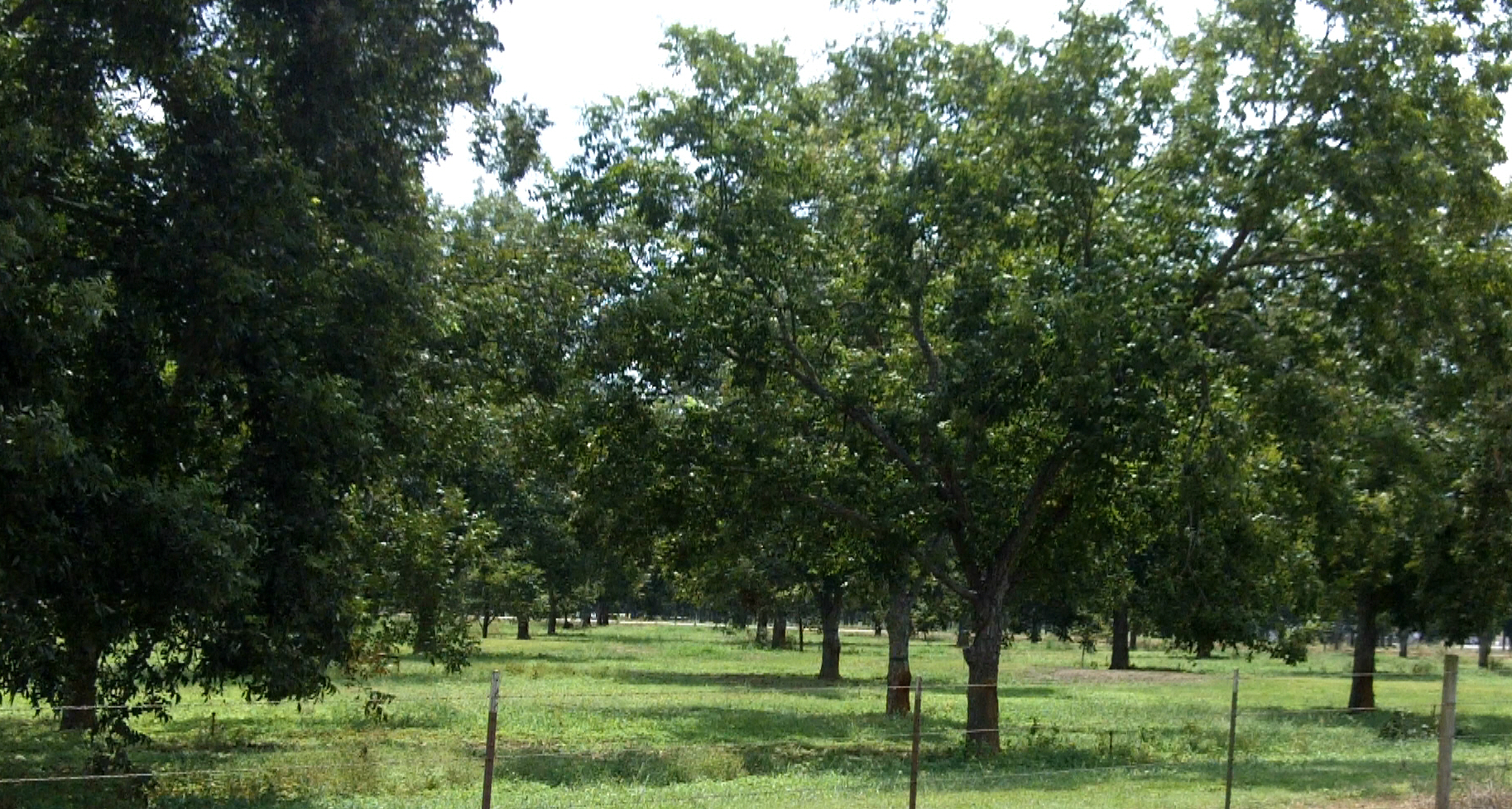
Texas pecan orchard. (Texas A&M AgriLife Extension Service photo by Kathleen Phillips)
 (Texas A&M AgriLife Extension Service photo by Kathleen Phillips)
Program coordinators Nesbitt and Dr. Larry Stein, AgriLife Extension horticulturist in Uvalde, will host several guest lecturers during the five-day program, including Dr. George McEachern, who has been lecturing at the event since its beginnings in the 1960s and author of the Texas Pecan Handbook.
Topics include plant physiology, health benefits of pecans, marketing, tax planning and integrated pest management.
“With pecans gaining national recognition for the increased export trade to China, short course enrollment in the last four years has been high,” Nesbitt said.  “Attendees not only get introduced to the basics of pecan growing, but they will get to see the U.S. Department of Agriculture Pecan Breeding Laboratory at Snook and the Texas A&M Storey Teaching & Research Pecan Orchard.”
Registration can be completed online at http://events.tamu.edu/EmsRegics/TexasPecanShortCourse2014. For more information, contact Nesbitt at 979-862-1218 or mlnesbitt@tamu.edu.

Monday, December 16, 2013

Sunflower Farming


A sunflower producer meeting has been scheduled for Wednesday afternoon, December 18, 1:00–3:00 pm at Helena in Honey Grove.

Dr. Calvin Trostle, Extension Specialist from Lubbock, will be on hand to discuss sunflower production in NE Texas. In addition, he has invited several sunflower companies to attend this meeting. We hope they will be able to attend and provide information on 2014 contracts for oil and confectionary sunflowers.

Questions? Contact

Michael R. Morrow
County Extension Agent-Ag
Lamar County
4315 Bonham St., Suite A
Paris, Texas 75460
903-737-2443

Tuesday, November 5, 2013

PESTICIDE APPLICATOR CEU TRAINING


Blackland Prairie Grazingland Conservation Initiative Tour


Submitted by:

Matt Machacek
Grazingland Specialist
Blackland Prairie Grazing Lands Conservation Initiative
USDA-NRCS
4321 West Hwy. 22
Corsicana, TX 75110
Office: 903-874-5131 ext. 113
Cell: 903-257-6633


The Blackland Prairie Grazingland Conservation Initiative purpose is to provide direct technical assistance to privately owned grazingland, and conduct outreach on different topics. Some major topics include ranch profitability, sustainability, and opportunities to improve our soil and forage resources.  From time to time we work with innovative ranches to host field days with the purpose of helping local ranchers network and find different technology that might fit their operations.

I would like to invite you to our 2013 Fall Grazing Tour on November 19th in Sherman, TX.  This tour will be located on Watson Farms.  Watson Farms is a 450 acre ranch divided into many paddocks with electric fence.  Stocker cattle are grazed at high density  to improve the forage base and focused management is being used to grow more beef per acre while staying profitable. Craig Watson is certainly an innovator and he will explain his approach to ranching profitably. 

This tour is scheduled from 9:30 to 12:00 and it is open to the general public.