|
Shared from Insects in the City
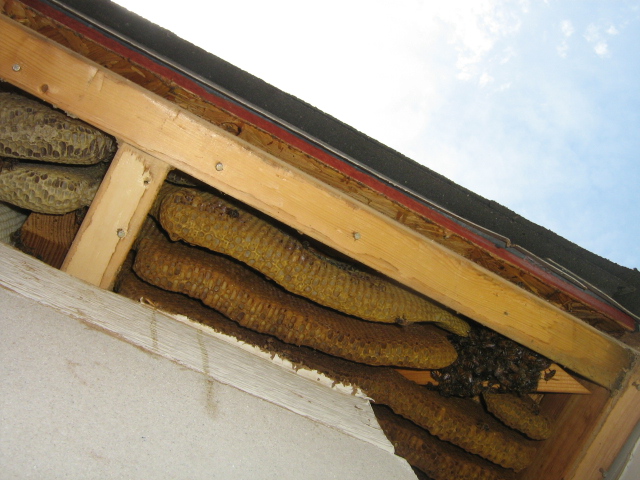
A few bees
entering a home usually means a nest is somewhere inside. This colony in a
roof soffit likely consists of 30,000 or more bees. The unpredictability of
bees means that a normally peaceful nest can turn dangerous quickly.
While honey bees are highly
beneficial to man, they can also be dangerous. If you don’t believe
this, consider two Texas incidents this summer. In June, a Waco area
man was killed by
honey bees while working on his tractor. This past
weekend a couple was
severely stung and two of their miniature horses were killed following
a bee attack at their Tarrant county home. Both incidents illustrate how
serious honey bee infestations can be.
It’s not that bees are mean, in a
human sense. But they do take exception to any people or animals that
threaten their nest, or colony.
So what should you do if you are
attacked by bees?
Run! Some people
make the mistake of standing in place and swatting bees, but this only gives
bees more time to recruit from the colony, and results in more stings.
Get to shelter as quickly as you can. Get in a car or building
that can be securely shut. If you encounter stinging bees and are a
long way from shelter, try to run through shrubs or brush to distract the
bees. If there is no shelter nearby, keep running until you leave the
bees behind. Some bees may pursue victims a half mile or more before giving
up the chase.
Don’t be fooled into
seeking escape in water. According to the Fort Worth
Star Telegram article, after failing to swat and swipe off the
bees, the Tarrant county couple tried diving in their pool. “We were trying
to stand up in the water but every time we stuck our heads out for air, they
would cover us and start stinging us,” she said. “We were trying to breathe
and they were stinging us in the face and in the nose.” Water is a poor
shelter from bee attack.
Once you’ve escaped
the swarm, remove any stingers from your skin as soon as possible. Honey bees
are one of the only stinging insects that leaves its stinger in the skin.
Left in the skin, the accompanying venom sac will continue to pump
venom. Pull the stingers out with a knife blade scraped gently across
the skin, or by scraping off with your finger nails.
Seek medical attention
immediately, especially if you experience hives, swelling around the throat
or face, or difficulty breathing. While an average healthy adult may
able to withstand hundreds of bee stings, for people with bee venom allergies
even a single sting can be highly dangerous.
Honey bee attacks have received
more media attention since Africanized honey bees entered the country in the
early 1990s. Africanized bees, while physically identical to domesticated
European bees first brought by settlers to this country about 300 years ago,
are genetically predisposed to be more aggressive than the European bee.
Africanized bees typically have a lower tolerance for nest disturbance,
will send more bees out in pursuit of an intruder, and will chase victims
further than their European cousins.
All wild bee colonies in Texas
should be assumed to be a hybrid between Africanized and European wild bees.
Beekeepers usually ensure that their colonies are founded on the more
docile European bees, so the threat from domesticated bees is less than wild
bees.
All of this is good reason to be
wary of any wild honey bee nest in your home or on your property. A
licensed beekeeper or pest control professional can help you get rid of bees.
For more information, see our publication E-346, Honey
bee control in and around homes.
 |
Tuesday, July 30, 2013
What to do if you’re attacked by bees?

Tuesday, May 28, 2013
New animal identification rules aid disease traceability
NEWS
RELEASE
For
Immediate Release – May 22, 2013
ARDMORE, Okla. —On March 11,
2013, the United States Department of Agriculture (USDA) initiated the Animal
Disease Traceability Program (ADTP) to track interstate livestock movement. The
new rule replaces the previous version of the National Animal Identification
System (NAIS) and pertains to all livestock, including cattle, horses, sheep
and goats.
According to the USDA, knowing
where diseased or at-risk animals are, where they have been and when, is
important to providing a rapid response when animal disease events take place.
This will reduce the impact of an animal disease event.
Noble Foundation Livestock
Consultant, Robert Wells, Ph.D., said the ADTP will require livestock that move
interstate to be accompanied by an Interstate Certificate of Veterinary
Inspection (ICVI), owner-shipper statement or a brand certificate. The
owner-shipper statement and brand certificate must be approved by officials in
both the state of origin and the receiving state. Animals moved intrastate will
be under the jurisdiction of the state’s regulations.
For cattle, the following are
deemed officially accepted forms of identification:
- Metal ear tags (brucellosis “orange” tag or National Uniform Eartagging System “Brite” tag).
- Plastic ear tags (with or without RFID, but must have a unique 15-digit code with 840 as the first three digits, the U.S. shield and manufacturer’s logo or trademark).
- Group or lot identification when applicable.
- Brands, when recognized by a brand inspection authority, accompanied by an official brand inspection certificate and allowed by the receiving state.
- Ear tattoos acceptable to breed registries when accompanied by a breed registration certificate or back tags when cattle are moved directly to slaughter.
Cattle are exempt if they are
moved directly to a livestock slaughter facility or to an approved livestock
tagging facility with an owner-shipper statement; moved from farm of origin to
a veterinary medical facility and then returned to the farm of origin (directly
from one state through another state and back to the original state); or moved
as a commuter herd with a copy of the commuter herd agreement.
“Ordinarily there is no
requirement for a producer to maintain a copy of the movement document, but it
is highly recommended that records be kept,” Wells said. “However, if an animal
loses an official ear tag, a replacement may be used. If this occurs, then
records that indicate the new identification number, the date it was
implemented and the old number must be maintained for five years.”
As beef cattle producers manage
their herds now and into the future, they will need to make sure that cattle
have compliant identification and they maintain those records necessary for
USDA compliance.
Federal rules require the
following animals to be officially identified:
- All sexually intact dairy cattle.
- All rodeo, exhibition or event cattle and horses.
- Sexually intact beef cattle over the age of 18 months.
- Equines that move interstate.
- Existing sheep and goat scrapie regulations apply.
Thursday, February 21, 2013
SPRING EXPO EVENT SCHEDULED
Spring is just around the corner, and with the arrival of spring comes
the need to get pastures and hay meadows
fertilized, work cattle, and plan for changes to be made in the coming
months. To celebrate the arrival of springtime, Texas AgriLife Extension
in Hunt County and the Northeast Texas Farmers Coop in Greenville will
be sponsoring a Spring Expo on Wednesday, February 27.
This event will be held from 10 a.m. to 3 p.m. at the Fletcher Warren
Civic Center, 5501 Business Highway 69, in Greenville. There will be
many vendors showcasing their products and answering producer questions
regarding, pastures, cattle management, fencing, vet supplies,
herbicides, livestock supplements, and other agricultural products.
Talks
will be given to update producers on sprayer calibration, weed control
and herbicides, improving pastures, soil testing, fertilizing,
rotational grazing, and more. In addition at noon, there will be a
hamburger lunch provided free of charge to all participants, and many
door prizes will be given away.
The
event is free of charge to all attending, compliments of the NET Farmers
Coop. A RSVP
is requested by February 26. More information can be
obtained, and reservations can be made by
calling the Coop at 903-455-6365 or the Extension Office at 903-455-9885.
Tuesday, February 19, 2013
USDA Announces 45th General Sign-up for the Conservation Reserve Program
Agriculture Secretary Tom Vilsack today announced that the U.S. Department of Agriculture (USDA) will conduct a four-week general sign-up for the Conservation Reserve Program (CRP), beginning May 20 and ending on June 14. CRP has a 27-year legacy of protecting the nation's natural resources through voluntary participation, while providing significant economic and environmental benefits to rural communities across the United States.
Currently, about 27 million
acres are enrolled in CRP. Producers that are accepted in the sign-up can
receive cost-share assistance to plant long-term, resource-conserving covers
and receive an annual rental payment for the length of the contract (10-15
years).
Contracts on 3.3 million acres
of CRP are set to expire on Sept. 30, 2013. Producers with expiring contracts
or producers with environmentally sensitive land are encouraged to evaluate
their options under CRP.
Additional sign-ups for
continuous CRP programs such as Highly Erodible Land Initiative and Initiative
to Restore Grasslands, Wetlands and Wildlife will be announced in spring 2013.
For more information on CRP and
other FSA programs, visit a local FSA service center or www.fsa.usda.gov.

Monday, February 18, 2013
Hispanic and Women Farmers and Ranchers Claims Period Ends March 25
Agriculture
Secretary Tom Vilsack reminds Hispanic and women farmers and ranchers
who allege discrimination by the USDA in past decades that there are 45
days remaining in the filing period closing March 25, 2013.
USDA urges potential claimants to contact the Claims Administrator for information
and mail their claim packages on or before March 25, 2013.
The
process offers a voluntary alternative to litigation for each Hispanic
or female farmer and rancher who can prove that USDA denied his or her
application for loan or loan servicing assistance for discriminatory
reasons for certain time periods between 1981 and 2000. As announced in
February 2011, the voluntary claims process will
make available at least $1.33 billion for cash awards and tax relief
payments, plus up to $160 million in farm debt relief, to eligible
Hispanic and women farmers and ranchers. There are no filing fees to
participate in the program.
Claimants may register for a claims package by calling the telephone number
below Monday through Friday 9 a.m. to 8 p.m. Eastern Time or by downloading the forms from the website.
Website: www.farmerclaims.gov
Phone: 1-888-508-4429
Claims Period: September 24, 2012 - March 25, 2013.
Independent
legal services companies will administer the claims process and
adjudicate the claims. Although there are no filing fees to participate
and a lawyer is not required to participate in the claims process,
persons seeking legal advice may contact a lawyer or other legal
services provider.
USDA
is an equal opportunity provider and employer. To file a complaint of
discrimination, write to USDA, Assistant Secretary
for Civil Rights, Office of the Assistant Secretary for Civil Rights,
1400 Independence Avenue, S.W., Stop 9410, Washington, DC 20250-9450, or
call toll-free at (866) 632-9992 (English) or (800) 877-8339 (TDD) or
(866) 377-8642 (English Federal-relay) or (800)
845-6136 (Spanish Federal-relay).
Thursday, January 17, 2013
USDA Finalizes New Microloan Program
Agriculture Secretary Tom
Vilsack unveiled a new microloan program today that will expand access to
credit for small farmers and ranchers and beginning and socially disadvantaged
producers.
The microloan application
process is simpler and requires less paperwork than traditional operating
loans. Additionally, the requirement for managerial experience and loan
security has been modified to ensure that small family operations and beginning
farmers and ranchers can obtain the credit needed to start and continue an
agricultural operation. This loan program will also be useful to specialty crop
producers and operators of community supported agriculture (CSA).
Eligible applicants can apply
for a maximum amount of $35,000 to pay for initial start-up expenses such as
hoop houses to extend the growing season, essential tools, irrigation, delivery
vehicles, and annual expenses such as seed, fertilizer, utilities, land rents,
marketing, and distribution expenses. As financing needs increase, applicants
can apply for an operating loan up to the maximum amount of $300,000 or obtain
financing from a commercial lender under FSA’s Guaranteed Loan Program.
Small farmers often rely on
credit cards or personal loans, which carry high interest rates and have less
flexible payment schedules, to finance their operations. The microloan program
will expand access to credit and provide a simple and flexible loan process for
small operators.
The current interest rate for
Microloans is 1.25 percent.
In addition to microloans, FSA
offers several farm loan programs that provide funding to purchase land,
livestock, equipment, feed, seed, and supplies, or can be used to construct
buildings or make farm improvements.
Producers interested
in applying for a microloan or other FSA farm loan program should contact their
local Farm Service Agency office
Subscribe to:
Posts (Atom)